
Samajwadi Party leaders Mulayam Singh Yadav and Amar Singh on Friday made it clear that they favoured the Indo-US nuclear deal as they met Prime Minister Manmohan Singh and Congress President Sonia Gandhi over the issue.
The bill clearly states what is required of India.
Notwithstanding the opposition posed to the nuclear liability bill, the United States on Monday said it is "optimistic and positive" about conclusion of the historic nuclear deal with India in the coming months.
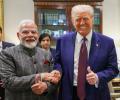
Modi lived up to his declaration that his visit was purely meant to strengthen India's relationship with the US, but there may be situations in which our silence on some issues will haunt us in the future, cautions Ambassador T P Sreenivasan.
The security situation in South Asia could get further complicated if the United States agrees to have a civilian nuclear deal with Pakistan, according to experts. Pakistan and the US are set to hold their first high-level strategic dialogue this week in Washington, co-chaired by US Secretary of State Hillary Clinton and Pakistan's Foreign Minister Shah Mehmood Qureshi. Pakistan wants a nuclear deal with the US on the lines of the ndo-US nuclear deal.

Weeks after 'breakthrough', substantial work is yet to be done
"China's cooperation with Pakistan in nuclear power is for peaceful means and is supervised by the International Atomic Energy Agency, (IAEA). The US always questions Pakistan's nuclear activities, but how about its latest nuclear deal with India," Chinese newspaper Global Times quoted He Maochun, director of the Research Centre for Economic Diplomacy Studies of Tsinghua University, as probing.
The country is planning to increase its nuclear power generation by about 60,000 mega watts (Mw) within the next 25 years. This planned capacity addition is being executed by the state-owned Nuclear Power Corporation of India Ltd (NPCIL). Its head, Chairman and Managing Director SK Jain, tells P B Jayakumar about his plans and expectations.
Even as the Indo-US nuclear deal is gathering dust on the backburner because of stiff opposition from the Left parties, Congress president and chairperson of United Progressive Alliance Sonia Gandhi on Friday underlined the importance of nuclear energy for the country at this juncture.
"We are committed to resolving all outstanding issues between our two countries through peaceful dialogue. There are certain concerns we have about infiltration, about violations of ceasefire, these I did raise and I hope that in the days and months to come the Government of Pakistan will have the wisdom to address some of them," said the prime minister.
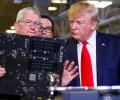
US President Donald Trump has threatened to impose tariffs on Apple products if the tech giant does not shift iPhone production from India to the United States. Trump said he expects iPhones sold in the US to be manufactured in America and not India, or anyplace else. He also said that he had a "little problem" with Apple CEO Tim Cook for building manufacturing facilities in India. Cook had previously said that the majority of iPhones sold in the US would have India as their country of origin. Experts say that shifting production to the US would be more expensive than assembling iPhones in India.
Keen to conclude the civil nuclear deal by the year-end, India and the US will hold another round of high level talks in July to sort out differences that have been nagging the negotiations for months.

'The die is cast. The wave is for her.' 'We will win this. The numbers are going to be higher than people are saying.' 'It is going to be more closer to Obama's numbers than Biden's numbers.'
External Affairs Minister Pranab Mukherjee met Communist Party of India - Marxist General Secretary Prakash Karat on Tuesday to discuss the India-United States civilian nuclear agreement. Mukherjee asked the Left Front to allow the United Progressive Alliance government to go ahead with the safeguards agreement with the International Atomic Energy Agency.

It is important for India to pay close attention to both the tone and substance of authoritative remarks coming out of Pakistan, explains former foreign secretary Shyam Saran.
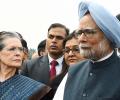
Former Indian Prime Minister Manmohan Singh passed away on Thursday night at the age of 92. He was brought to the emergency department of AIIMS Delhi in critical condition after "sudden loss of consciousness."

The move by Westinghouse, which is to build six reactors in India under the Indo-US civil nuclear deal inked in 2008, has raised uncertainties over the future of the implementation of the historic pact.
The reaction came a day after Gandhi obliquely attacked the Left, saying that "elements" opposing the nuclear agreement were not only "enemies" of the Congress, but also of the nation's progress and development.
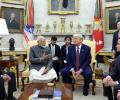
'By his words, actions, and body language during their joint press appearance wanted to convey his personal respect and, more broadly, his desire to work closely with India.'

'Unfortunately, India and Pakistan could learn a 'lesson' from this conflict that will make them more likely to use these weapons against each other in the future.' 'Rounds of missile and drone attacks could be more routine features of their hostility, just like artillery fire has become a familiar fact of life along the Line of Control.'

Khamenei said: "We do not violate the deal, but if the other party violates it, if they tear the agreement up, we will light it on fire."
Experts have said that the deal appears to be violating international guidelines forbidding nuclear exports to countries that have not signed the nuclear Non-Proliferation Treaty or do not have international safeguards on reactors.
From the resurrected cash-for-votes scandal to a rigged process favouring four foreign vendors -- and from new safety concerns to the special legislation that caps the foreign suppliers' accident liability by burdening the Indian taxpayer -- the nuclear deal's future looks more troubled than ever, says Brahma Chellaney.
"If there is any change, I will not accept it," said Rao, who heads the Prime Minister's Scientific Advisory Council.
The chairman of India's Atomic Energy Commission makes a case for nuclear energy saying all other forms of power gerenration will not be able to meet the country's staggering demand.

The CPI-M on Tuesday warned the UPA government at the Centre would "face the consequences" if it went ahead with the Indo-US nuclear deal. CPI-M politburo member Sitaram Yechuri said the outcome of the discussion between India and IAEA regarding the nuclear deal would be conveyed to Left parties by the government on March 17 at the Left-UPA Coordination Committee meeting.
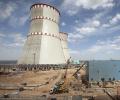
China on Tuesday inked an agreement worth a whopping USD 4.8 billion with cash-strapped Pakistan to set up a 1,200-megawatt nuclear power plant as a sign of increasing strategic cooperation between the two all-weather allies.
India and the US on Friday operationalised the "path-breaking" bilateral nuclear deal as they signed the 123 Agreement here, with New Delhi insisting that the accord is "legally-binding" on both sides.
"The enemies of the country want to project the militancy in the country as indigenous and for this purpose, they have been recruiting some local youth for arms training," he said.
In perhaps what could be his swansong appearance as the Obama administration's point man for South Asia, Robert Blake has acknowledged that the impasse over the implementation of the US-India civilian nuclear deal poses many challenges to Washington and New Delhi.

Harris slammed President Donald Trump and pledged to 'rejoin' the Paris agreement on Climate Change and 'strengthen and re-enter' the Iran nuclear deal. "Joe Biden and our administration is gonna have a massive job to repair the damage done by Donald Trump and his administration, and to restore our place in the world," she said.
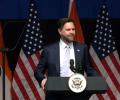
US Vice President JD Vance called on India to drop non-tariff barriers, give greater access to its markets and buy more American energy products and military hardware. Vance, in a speech in Jaipur, highlighted the need for a stronger US-India partnership for a prosperous and peaceful 21st century. He emphasized the importance of working together to address global challenges and praised Prime Minister Narendra Modi, describing him as a "special person." Vance also urged India to provide greater market access to American products and buy more defense platforms and energy from the US. He suggested that India consider dropping some of the non-tariff barriers for American access to the Indian market and highlighted the benefits of closer India-US defense collaboration, advocating for New Delhi to procure more military hardware from the US. He cited the example of American fifth-generation F-35s, arguing they would give the Indian Air Force the ability to defend its airspace and protect its people like never before. Vance also welcomed the Modi government's budget announcement to amend India's civil nuclear liability laws, paving the way for US producers to export small modular reactors and build larger US-designed reactors in India. He emphasized the importance of energy security for India's AI ambitions, stating "there is no AI future without energy security and energy dominance." Vance's visit comes amid growing global concerns over the US's tariff war.
Pakistan appears to be reconciled to a long haul in clinching a civil nuclear deal with the US with President Asif Ali Zardari today saying it took nine years for India to secure an atomic pact with Washington.
"The draft will also be put on the government of India website to facilitate a larger discussion," he said.
'India has had seven years after the 1998 tests, what has it done on the weapons front?'
Ajit Jain, rediff India Abroad, managing editor, Canada, who is traveling with Canadian Prime Minister Stephen Harper on his first-ever visit to India, reports on future course of the civilian nuclear deal that is underway between the two countries.
"The N-deal is not only the highest visible symbol of cooperation between India and the United States, it represents a new turn -- it is a very special cooperation."
On his first visit to Washington after taking over as foreign secretary, Menon on Wednesday had a three-hour-long discussion with Burns, who is the key negotiator for the nuclear deal.
